
The five ship classes, and which one to learn first
This page carries a partner link. If you register through it, BRSM s.r.o. may be paid a commission by the advertiser. It costs you nothing extra and does not influence what is written here. See our advertising disclosure and editorial policy.
Most people who give up on World of Warships in the first week did not pick a bad ship. They picked a class that does not match the way they like to play. Here is what each of the five classes actually does on the water.
Destroyer (DD)
Plays like: a scout and an assassin.
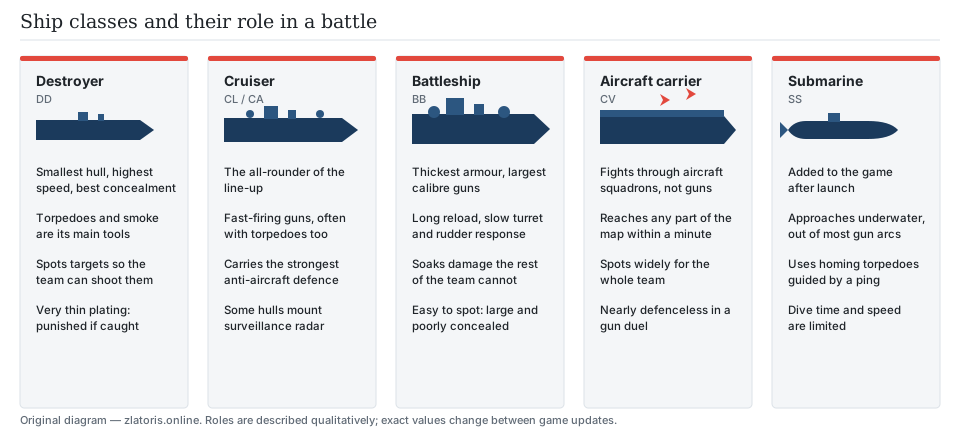
The smallest hulls, the highest speed and by a distance the best concealment in the game. A destroyer's job is to take and hold the capture areas at the start of the battle and to spot the enemy so that the rest of the team can shoot at it. Its weapons are torpedoes — slow, silent and devastating — and quick-firing guns that are dangerous to other destroyers and irritating to everything else. It can lay a smoke screen to break line of sight.
What goes wrong: the armour is nominal. Being spotted by a radar cruiser at the wrong moment is usually fatal, and there is very little you can do about it once it has happened. The class rewards patience and map reading, and punishes impatience harder than any other.
Cruiser (CL / CA)
Plays like: the all-rounder, and the team's problem-solver.
Cruisers sit in the middle of everything: fast-firing guns that set fires, frequently torpedoes, the best anti-aircraft defence in the game, and on some hulls a surveillance radar that finds hidden destroyers regardless of line of sight. A good cruiser player supports the destroyers early, punishes enemy destroyers, and then works battleships from a distance with high-explosive fire.
What goes wrong: a cruiser that shows its side to a battleship at medium range is dead in one salvo. The class demands constant attention to angle and to the ranges of the guns that can reach you.
Battleship (BB)
Plays like: a slow, heavy anchor for a flank.
The thickest armour and the largest guns. A battleship is the ship the rest of the team positions around: it absorbs fire nobody else could survive, and one accurate armour-piercing salvo into an exposed cruiser can end that cruiser instantly. It reloads slowly, turns slowly and takes a long time to reach anywhere, so every positioning decision has a long tail.
What goes wrong: impatience. Sailing straight at the enemy alone, broadside, in the first four minutes is the single most common way a battleship match is lost — for the battleship and for the flank it abandoned.
Aircraft carrier (CV)
Plays like: a separate game played on the same map.
Carriers do not fight with guns. You fly squadrons directly, attack with bombs, rockets or aerial torpedoes, and spot for the whole team from the air. A carrier can put pressure on any part of the map within a minute — an ability no other class has. The control scheme was reworked substantially in 2019 from the original real-time-strategy style to direct squadron control, so guides written before that describe a different game.
What goes wrong: the ship itself is nearly defenceless. If a destroyer reaches you, the battle is over. Carriers are also the class most often blamed by everyone else, fairly or not.
Submarine (SS)
Plays like: a slow, patient ambush.
Submarines were added well after launch. Following a long testing period they entered random battles in early access from late 2022, with further national lines arriving through 2023. They approach underwater, out of reach of most guns, and attack with torpedoes that home in on a target that has been marked with an acoustic ping. Depth and underwater speed are limited, so a submarine that mistimes a dive is exposed.
What goes wrong: they remain the most argued-about class in the game, and their handling has been changed repeatedly. Expect the details to have moved since anything you read about them — including this page.
So which should you start with?
| If you like… | Start with | Because |
|---|---|---|
| Learning the whole game quickly | Cruiser | You will meet every mechanic — angling, fires, radar, aircraft — within a few battles. |
| Stealth, timing and map control | Destroyer | The highest skill ceiling and the steepest lessons. |
| Slow, heavy, deliberate play | Battleship | Forgiving of reaction time, unforgiving of bad position. |
| Managing things from above | Aircraft carrier | A different game with its own learning curve; not a good first class. |
| Ambushes and patience | Submarine | Interesting, but still changing; learn the surface game first. |
Whatever you choose, start at a low tier. Tiers III to V have cheap repair bills, forgiving opponents and all the mechanics that matter. The full guide explains gunnery, armour, spotting and the economy in detail.
Partner link. If you register through it, BRSM s.r.o. may receive a commission from the advertiser. It costs you nothing extra and changes nothing about the offer you receive.
Sources: the game client's tech tree and ship panels, and the publisher's patch notes, checked at the time of writing. Mechanics change between updates; where this page differs from the publisher's own information, the publisher's information prevails. The diagram above is an original SVG drawn for this site.